From Onboarding to Resilience: Why “Being Live” Isn’t Enough in iGaming Payments

Over the past few weeks, we’ve been asking iGaming operators a direct question: how much pressure can your payment infrastructure absorb before it disrupts cash flow?
Not in theory, and not in next year’s planning cycle, but in production, when volumes spike, compliance scrutiny intensifies, an acquiring bank shifts its risk posture, or a provider pauses unexpectedly.
The pattern is consistent. Most payment stacks are engineered to pass approval and go live. Far fewer are engineered to remain stable under sustained regulatory and banking pressure. Approval is a milestone. Resilience is an operating model.
Approval Is a Starting Point, Not a Safeguard
In iGaming, onboarding is demanding and often complex. Securing acquiring support requires licensing clarity, AML controls, chargeback management discipline, and demonstrable governance. Once approval is achieved and processing begins, attention understandably shifts toward growth.
However, the operating characteristics of high-volume iGaming businesses introduce structural stress from day one. Transaction frequency is extreme. Traffic patterns are volatile and event-driven. Payout velocity is high. Geographic expansion is rarely linear. Campaign success can alter processing volumes overnight.
A stack designed solely to satisfy onboarding requirements may function during stable periods, but it is not inherently designed to absorb volatility. The difference between “approved” and “production-ready” becomes visible only when stress is applied.
Compliance Pressure Rarely Begins With Enforcement
One of the most important realities in production environments is that regulatory or bank pressure almost never begins with formal action. It builds gradually and often subtly.
Operators typically observe changes such as slower or more conditional responses from acquirers, increased transaction monitoring, deeper KYC and source-of-funds requests — particularly for high-value players — or reduced appetite for volume growth in certain jurisdictions.
These are not random operational inefficiencies. They are indicators of internal risk reassessment within acquiring institutions.
Teams that interpret these signals early can adjust before formal restrictions are introduced. Those that do not often experience the outcome as abrupt, even though the progression was incremental.
Fallback Must Exist in Production, Not on Paper
When tolerance tightens or a provider pauses, the critical question is not whether a fallback plan exists conceptually, but whether it exists operationally.
A production-grade fallback architecture includes live secondary acquiring rails, active payout redundancy, predefined routing logic, and agreed volume thresholds that are already understood by counterparties. Importantly, traffic must already be flowing through secondary paths in controlled volumes so that shifts appear operational rather than exceptional.
If a disruption triggers emergency onboarding, new routing development, or last-minute volume negotiations, the fallback strategy remains theoretical. In high-velocity models such as iGaming, theoretical resilience translates directly into cash-flow exposure.
Resilience Is Both Technical and Relational
Operators often frame resilience as a technology question, yet its effectiveness depends equally on governance and partnership depth. Acquiring confidence is built through ongoing dialogue, predictable scaling frameworks, and clarity around future geographic or volume ambitions.
Where this work is maintained proactively, whether internally or through an experienced ISO, volume adjustments are absorbed within expected parameters. Where it is deferred, routine operational shifts can be interpreted as risk events.
Infrastructure without relationship management is incomplete. Resilience requires both.
From Framework to Evaluation
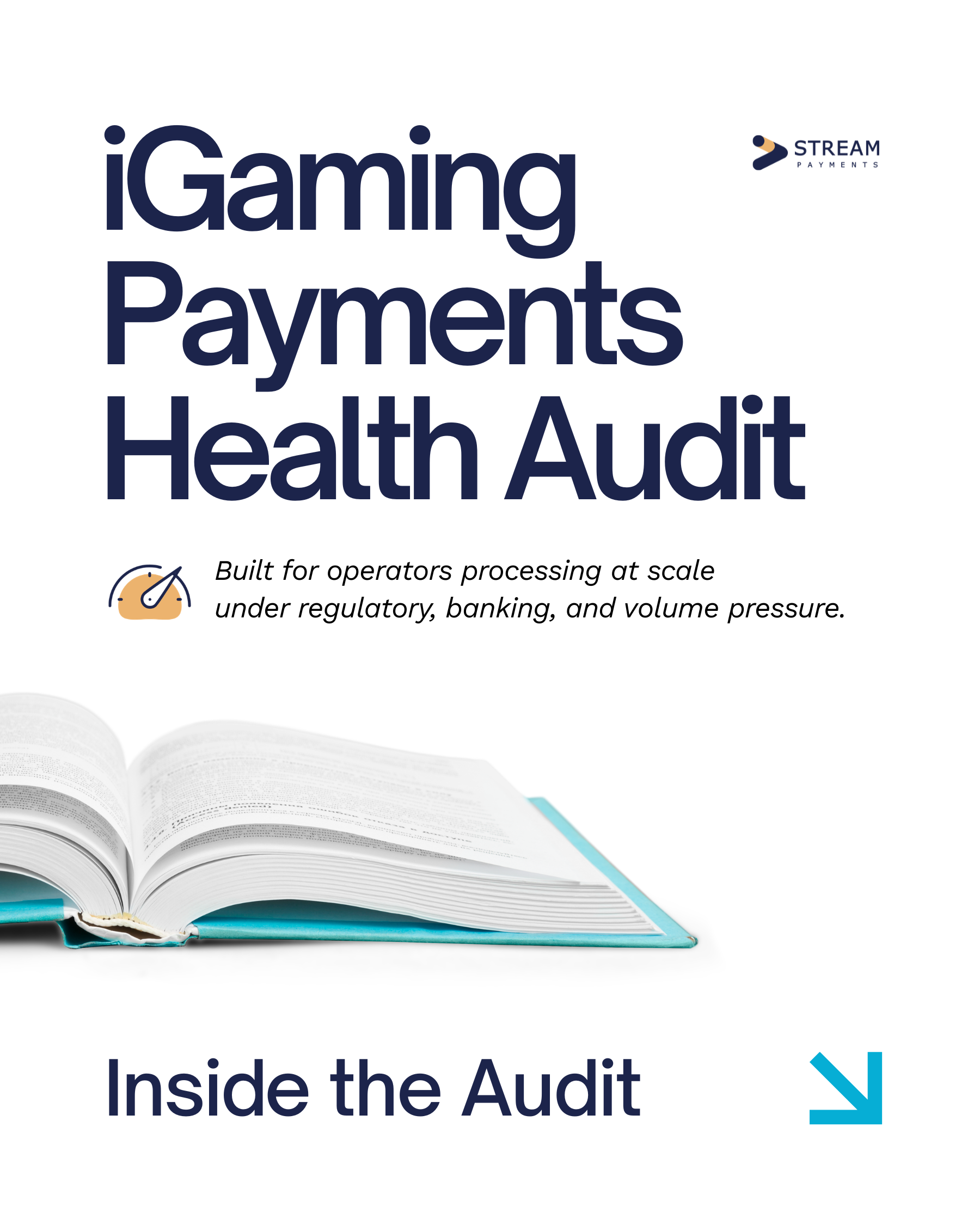
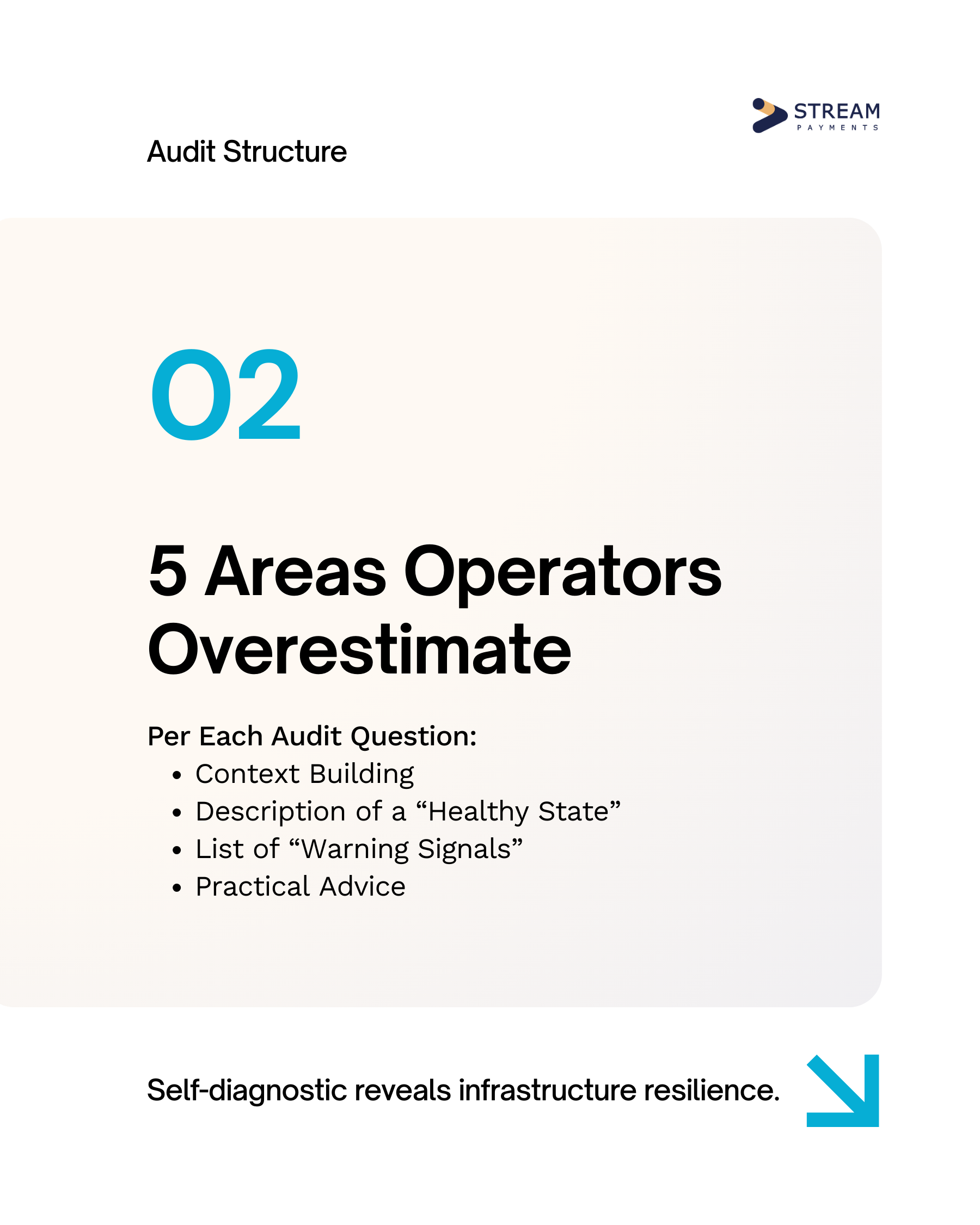
The discussions that informed this series were drawn from production-level conversations with operators managing scale across multiple jurisdictions. To translate those themes into something usable, we structured them into a practical diagnostic: the iGaming Payments Health Audit (Q1 2026)
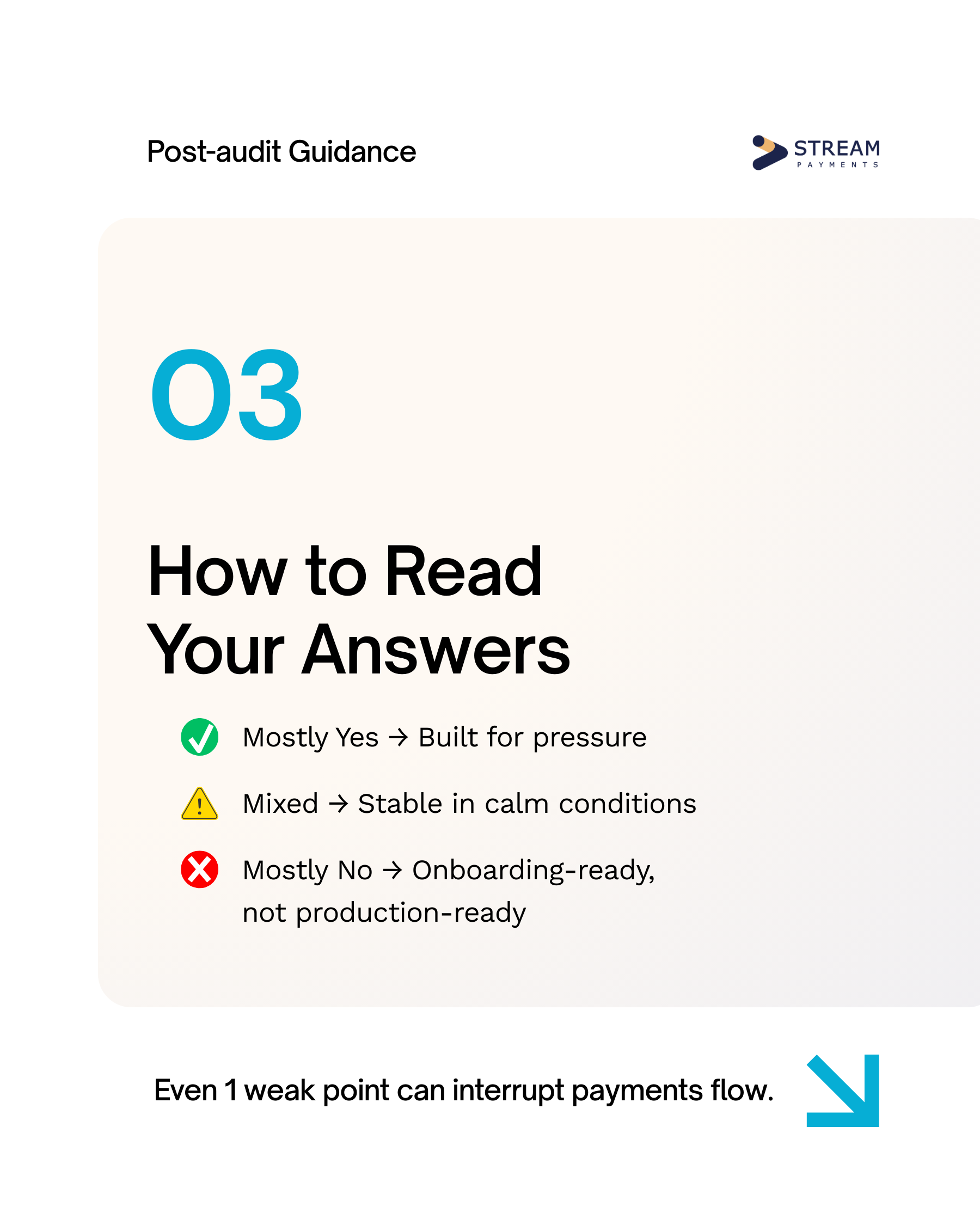
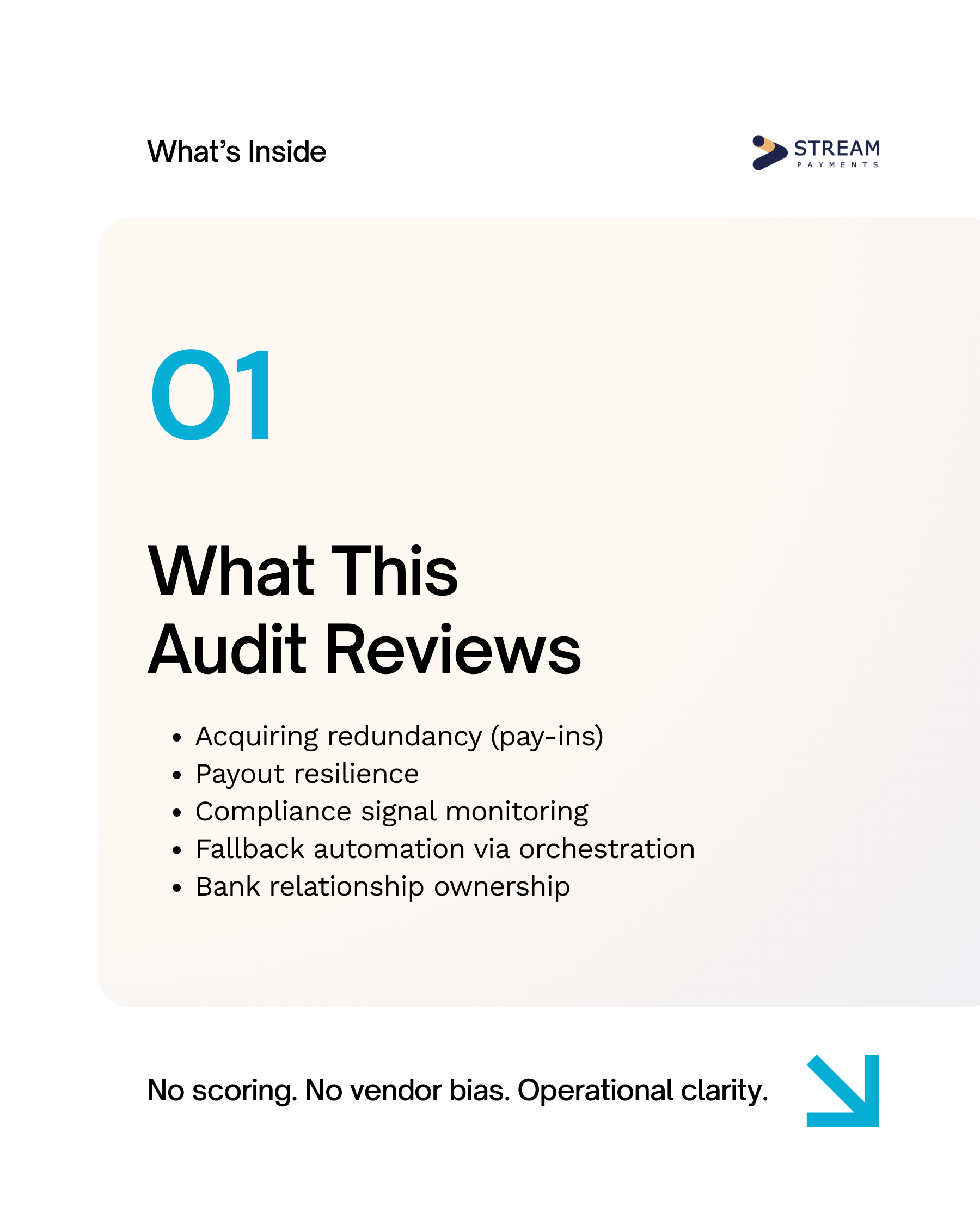
The audit is not designed as a marketing asset, nor as a scoring mechanism. It is an operational review intended to help teams assess whether their acquiring structure, payout resilience, monitoring depth, fallback automation, and partnership governance are genuinely production-ready.
Each category is evaluated solely on what is currently live in production. Controls that are planned but not implemented are treated as exposure, not mitigation.
Even a single weakness in acquiring redundancy, payout resilience, or fallback automation can interrupt deposits or withdrawals. In high-volume environments, that interruption is not theoretical; it is immediate.
Executive Considerations
For operators managing scale, the appropriate starting point is internal clarity.
Are acquiring relationships structured around predictable growth rather than episodic approval? Is fallback capacity formally understood by counterparties? Are monitoring frameworks granular enough to detect pressure before it escalates? Is ownership of bank dialogue clearly defined
If those answers are clear and supported by live infrastructure, the stack is likely positioned for resilience. If not, the exposure exists regardless of current performance.
Accessing the Audit
The full iGaming Payments Health Audit (Q1 2026) is available as a downloadable PDF below. It is intended for use by payments, finance, and compliance teams as a structured internal review.
Operators can then determine, based on operational evidence rather than assumption, whether their infrastructure is engineered merely for onboarding approval or for sustained production pressure.