
SAQ A merchants whose website redirects to or embeds a third-party payment page are required under PCI DSS v4.0.1 to run external vulnerability scans every 90 days, performed by a certified Approved Scanning Vendor. Many arrive at onboarding without knowing this applies to them.
We see it often enough that it has stopped surprising us.
A common scenario is a merchant has finished the integration, the go-live date is on the calendar, and then the acquirer asks for a passing ASV scan report. Some merchants have never heard of one. Others assumed that because the payment page is hosted by someone else, the scan is someone else's job too.
When that happened, we would advise the merchant to find a scanning vendor. If you have never bought a scan before, that’s easier said than done. You do not know where to start, and the search eats time at exactly the point where the onboarding relationship should be picking up momentum.
That is what pushed us to make ASV scanning available directly as part of onboarding. This post covers what the requirement is, why it catches merchants by surprise, and what we now provide so merchants can meet it without stepping out of the onboarding conversation.
Why do vulnerability scans matter?
The case for scanning is easy to make with numbers. Between 2020 and 2023, disclosed vulnerabilities rose 44%, from 18,350 to 26,447. In 2023, 25% of high-risk vulnerabilities were exploited on the day they were disclosed, and another 50% of them within 19 days (PCI Security Standards Council resource guide, 2024).
Internet-facing systems are the most exposed part of any payment setup because they are easy to reach and easy to exploit. Once one is compromised, an attacker can get to payment account data as it is being entered and processed.
Merchants must ensure that vulnerability scanning covers all internet-facing systems within scope, including websites, payment pages and any supporting components that connect to or provide access to the cardholder data environment (CDE).
What is SAQ A, and who does it cover?
SAQ A stands for Self-Assessment Questionnaire A. It is the PCI DSS category for e-commerce merchants whose payment processing is fully outsourced to a third-party payment service provider (TPSP), through either a redirect or an iframe. Card data never touches the merchant's own systems. The payment happens on the TPSP's page.
Under PCI DSS v3.2.1, SAQ A was the lightest category in the standard, at 24 controls. A control is a single requirement a merchant must confirm it meets when it completes its self-assessment. Under v4.0.1, SAQ A has 31 controls, and ASV scans are part of them for the first time.
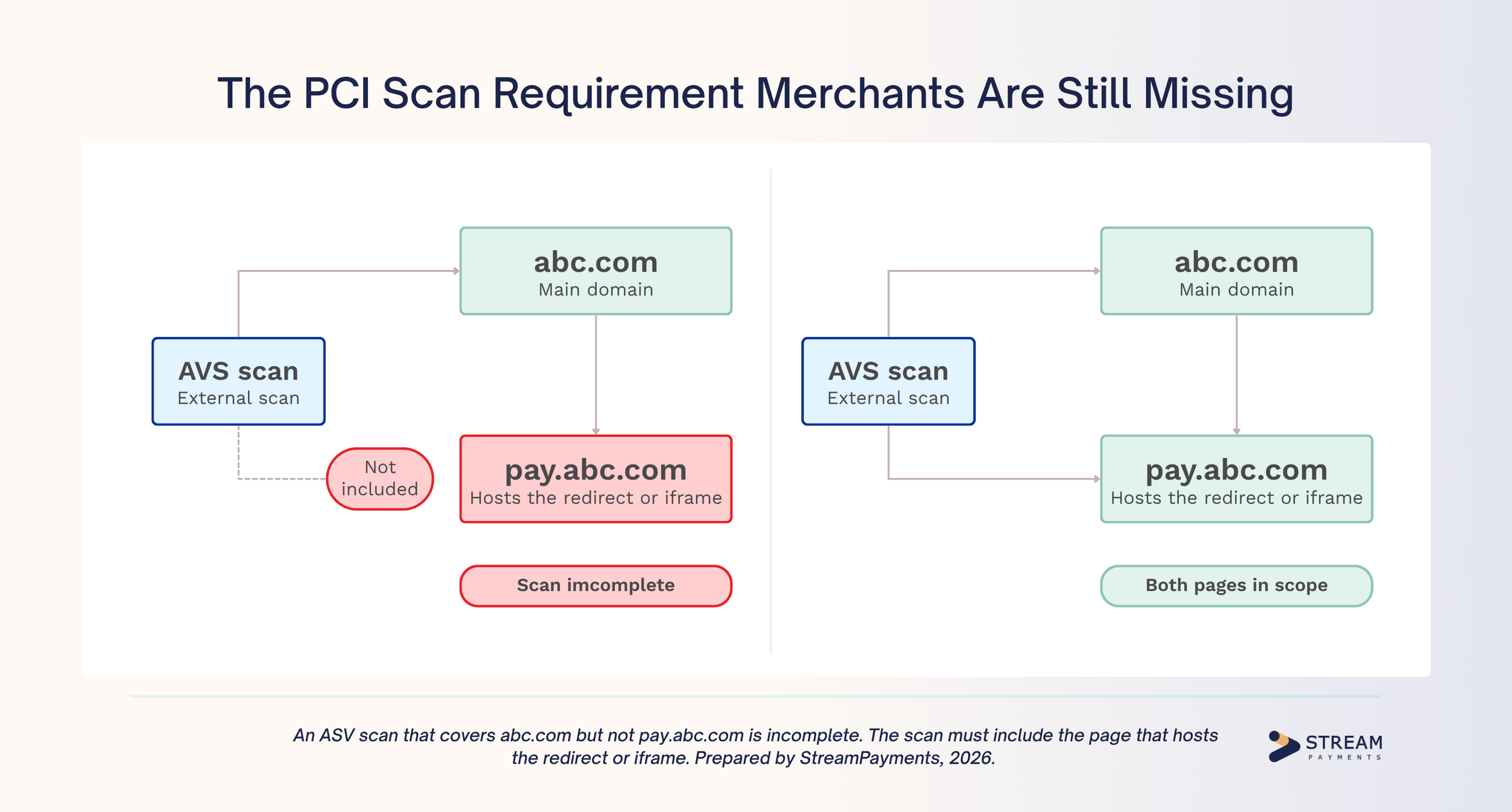
Here is where it gets practical. For SAQ A merchants, the scan has to cover the page on your own website that redirects customers to the payment provider or embeds the payment form. In our experience at onboarding, many merchants scan their main domain and leave that page out. If abc.com is scanned but pay.abc.com is not,Req. 11.3.2.1 will not be fully met.
Incomplete scan
Only the main domain is scanned
Complete scan
The payment page is scanned too
Light History for Context: What changed on April 1, 2025?
PCI DSS v4.0.1 became the sole active standard on March 31, 2025, and v3.2.1 was retired. From April 1, 2025, SAQ A merchants whose website redirects to or embeds a third-party payment page have been required, for the first time, to run quarterly external vulnerability scans of their internet-facing systems using an Approved Scanning Vendor.
Two requirements carry the detail. Req. 11.3.2 calls for external vulnerability scans at least every 90 to 92 days, performed by a certified ASV. Req. 11.3.2.1 calls for an additional scan after any significant network change.
The PCI Security Standards Council added scans to SAQ A to address common breaches targeting these merchant environments. It is not an upcoming requirement. A merchant who has not run a passing scan since April 2025 is already operating outside it.
Doesn't my payment provider already cover this?
Most SAQ A merchants assume it does. The PCI Security Standards Council says not to assume.
The question to ask your provider is specific: is my website, including its external IP address, domain name, or URL, included in your ASV scans? Being PCI DSS compliant for hosting services is one thing. Having your particular website named in the scans is another. If it is not included, arranging a scan becomes your responsibility.
Ask for the answer in writing. A verbal "we're covered" will not help you when an acquirer asks for evidence.
What is an ASV scan, and what does it produce?
An ASV scan is an external vulnerability scan of the internet-facing systems connected to your payment environment. It runs from outside your network, the same way an attacker would probe it, and checks every public IP, domain, and system for known vulnerabilities, weaknesses, and misconfigurations.
A passing scan means the report contains no vulnerabilities ranked medium or high. A failing scan means remediation is required, and rescans have to be run until the result passes.
After a passing scan, the merchant receives a PCI Executive Report and a PCI Technical Report. Together they serve as the Attestation of Scan Compliance, which is what gets submitted to the acquirer.
The scan has to be performed by a PCI SSC-certified Approved Scanning Vendor, using that vendor's PCI-approved scan solution.
Which merchants need ASV scans?
For e-commerce merchants, ASV scans apply across SAQ A, A-EP, and D. SAQ D merchants have carried this requirement the longest. April 2025 extended it to SAQ A for the first time. Any merchant with internet-facing systems connected to its payment environment should confirm whether it is in scope.
Comparison table: ASV scan requirement by SAQ type
ASV scan requirement by SAQ type
ASV scans apply across all three, but the onboarding gaps differ
| Requirement | SAQ A | SAQ A-EP | SAQ D |
|---|---|---|---|
| Who it applies to | E-commerce merchants using a third-party payment page via redirect or iframe | E-commerce merchants with payment scripts hosted on their own website | All other e-commerce merchants not covered by SAQ A or SAQ A-EP |
| Card data handled by merchant | No. Payment processing happens entirely on the TPSP's page. | Partially. Merchant's own scripts interact with the payment flow. | Yes. Merchant stores, processes, or transmits card data. |
| ASV scan required | Yes | Yes | Yes |
| When requirement began | April 1, 2025. New under PCI DSS v4.0.1. | Prior to PCI DSS v4.0.1. | Prior to PCI DSS v4.0.1. |
| Common gap at onboarding | Merchant assumes TPSP handles the scan requirement. | Merchant underestimates their own system's scope. | Merchant knows they are in scope but may not have a certified ASV in place. |

Why do acquirers care about ASV scans?
Acquirers collect Attestation of Scan Compliance evidence from their merchants, and they ask for it at onboarding. They also face card brand fines for non-compliant merchants and pass those costs downstream. A merchant who cannot produce passing scan results leaves a compliance gap sitting directly in the acquirer's portfolio.
It is the same dynamic we wrote about in our post on why the most critical phase of an acquiring relationship begins after approval.
What do we provide?
We offer a scanning service as an option for merchants who want it arranged for them. The scan is conducted by a PCI SSC-certified Approved Scanning Vendor. Merchants receive the PCI Executive Report and the PCI Technical Report they need to submit to their acquirer as the Attestation of Scan Compliance.
We offer it at onboarding, for the quarterly scans that follow. It is available to SAQ A merchants and to merchants in the other SAQ categories where the requirement applies, including merchants that do not process with us.
If your website hosts an iframe or redirects to a TPSP’s payment page and you have not completed a passing ASV scan since April 2025, the requirement is already overdue.
If you would rather not search for a scanning vendor, we can arrange the scan for you, at onboarding or at any point after.
FAQs
-
Yes, if your website redirects to or embeds a third-party payment page. Since April 1, 2025, PCI DSS v4.0.1 has required these merchants to run external vulnerability scans. A certified Approved Scanning Vendor (ASV) must perform them. It was new for SAQ A, and it is not an upcoming requirement.
-
At least every 90 to 92 days, under Requirement 11.3.2. A report from one quarter does not cover the next. Requirement 11.3.2.1 also calls for an additional scan after any significant change. A merchant who has not run a passing scan since April 2025 is already operating outside the requirement.
-
Not necessarily. The PCI Security Standards Council says not to assume. Ask whether your specific website is named in your provider's ASV scans. That means your external IP address, domain name, or URL. Being PCI DSS compliant for hosting is a different thing. If your website is not included, arranging a scan is your responsibility. We advise getting the answer in writing.
-
The scan has to cover one page on your own website. That is the page that redirects customers to the payment provider or embeds the payment form. Many merchants scan their main domain, such as abc.com, and leave that page out. If abc.com is scanned but pay.abc.com is not, the scan is incomplete.
-
The PCI Security Standards Council defines a passing ASV scan as one with no vulnerabilities ranked medium or high. In practice, that generally means two things. No vulnerability scores 4.0 or higher on the Common Vulnerability Scoring System (CVSS), a 0 to 10 severity scale. And nothing triggers an automatic failure. A failing scan requires remediation, then rescans until the result passes.
-
After a passing scan, the merchant receives scan reports that together serve as the Attestation of Scan Compliance. That is the evidence submitted to the acquirer. The scan must be performed by a PCI SSC-certified ASV using its PCI-approved scan solution. Not every scan an ASV sells qualifies.
-
For e-commerce merchants, ASV scans apply across SAQ A, SAQ A-EP, and SAQ D. April 2025 extended the requirement to SAQ A for the first time. Any merchant with internet-facing systems connected to its payment environment should confirm whether it is in scope.
-
Acquirers collect Attestation of Scan Compliance evidence from their merchants, and they ask for it at onboarding. A merchant who cannot produce passing scan results leaves a compliance gap inside the acquirer's portfolio. In our experience, the request often arrives after the integration is finished and the go-live date is set.
-
Yes. We arrange scanning by a PCI SSC-certified Approved Scanning Vendor at onboarding and for the quarterly scans that follow. It is also available to merchants in other SAQ categories where the requirement applies. That includes merchants that do not process with us. The PCI obligation itself stays with the merchant.
